

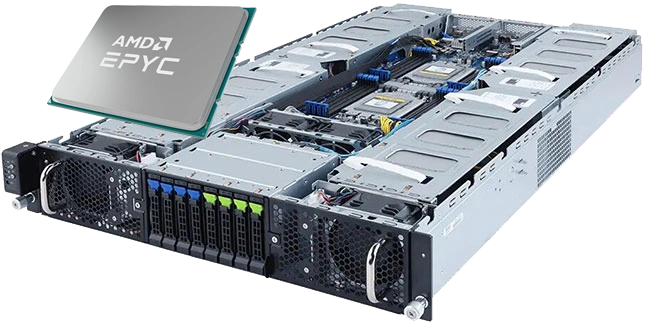
Yes. For environments like Proxmox and VMware, AMD EPYC typically offers higher core counts, more memory channels, and superior PCIe lane availability compared to Intel Xeon, resulting in better performance-per-dollar for dense VM hosting.
While a 128 core server cost might seem like a premium investment upfront, it drastically lowers your TCO. By consolidating multiple smaller servers into one dual amd epyc server, you save significantly on software licensing, rack space, and power consumption.
Absolutely. While known for big data, high-frequency models like the EPYC 4000 series (Zen 4) or Milan-X (with 3D V-Cache) are exceptional for Virtual Desktop Infrastructure (VDI) like AMD Horizon, and provide the single-core burst speeds required for large multiplayer game servers.
Yes. Every epyc barebones server comes with full root/administrator access and dedicated IPMI out-of-band management, giving you 100% architectural control over your deployment.
Unlike legacy architectures that bottleneck I/O, a single AMD EPYC processor provides up to 128 PCIe 4.0 or 5.0 lanes natively directly from the CPU. This allows ServerMO to attach dozens of high-speed U.2 NVMe SSDs and multiple NVIDIA or AMD GPUs without relying on PCIe PLX switches. The result is zero-latency data paths, making it the ultimate backbone for Software-Defined Storage (Ceph/ZFS) and AI training servers.
AMD EPYC utilizes a revolutionary multi-chiplet (CCD) design paired with a central I/O die. Supporting up to 12 memory channels (DDR5 on 4th/5th Gen), it delivers unprecedented memory bandwidth. Cloud architects can optimize memory latency for specific workloads by adjusting the NPS (NUMA nodes Per Socket) BIOS settings (NPS1, NPS2, or NPS4) via our IPMI interface, ensuring maximum efficiency whether you are running a monolithic SQL database or highly distributed Kubernetes microservices.
Yes. Starting with 4th Gen EPYC (Genoa / Zen 4), AMD introduced full AVX-512 instruction set support. Unlike previous industry implementations, AMD processes 256-bit instructions efficiently without the severe frequency drops (thermal throttling) traditionally associated with AVX-512 workloads. This provides a massive performance boost for AI inferencing, financial modeling, and scientific simulations.
Secure Encrypted Virtualization with Secure Nested Paging (SEV-SNP) is an advanced AMD Infinity Guard feature available on 3rd Gen (Milan) and newer EPYC processors. It provides cryptographic isolation for Virtual Machines, protecting them even against malicious or compromised hypervisors. This makes our EPYC bare metal the strictest compliant infrastructure for highly classified healthcare (HIPAA), financial (PCI-DSS), and confidential cloud computing workloads.