


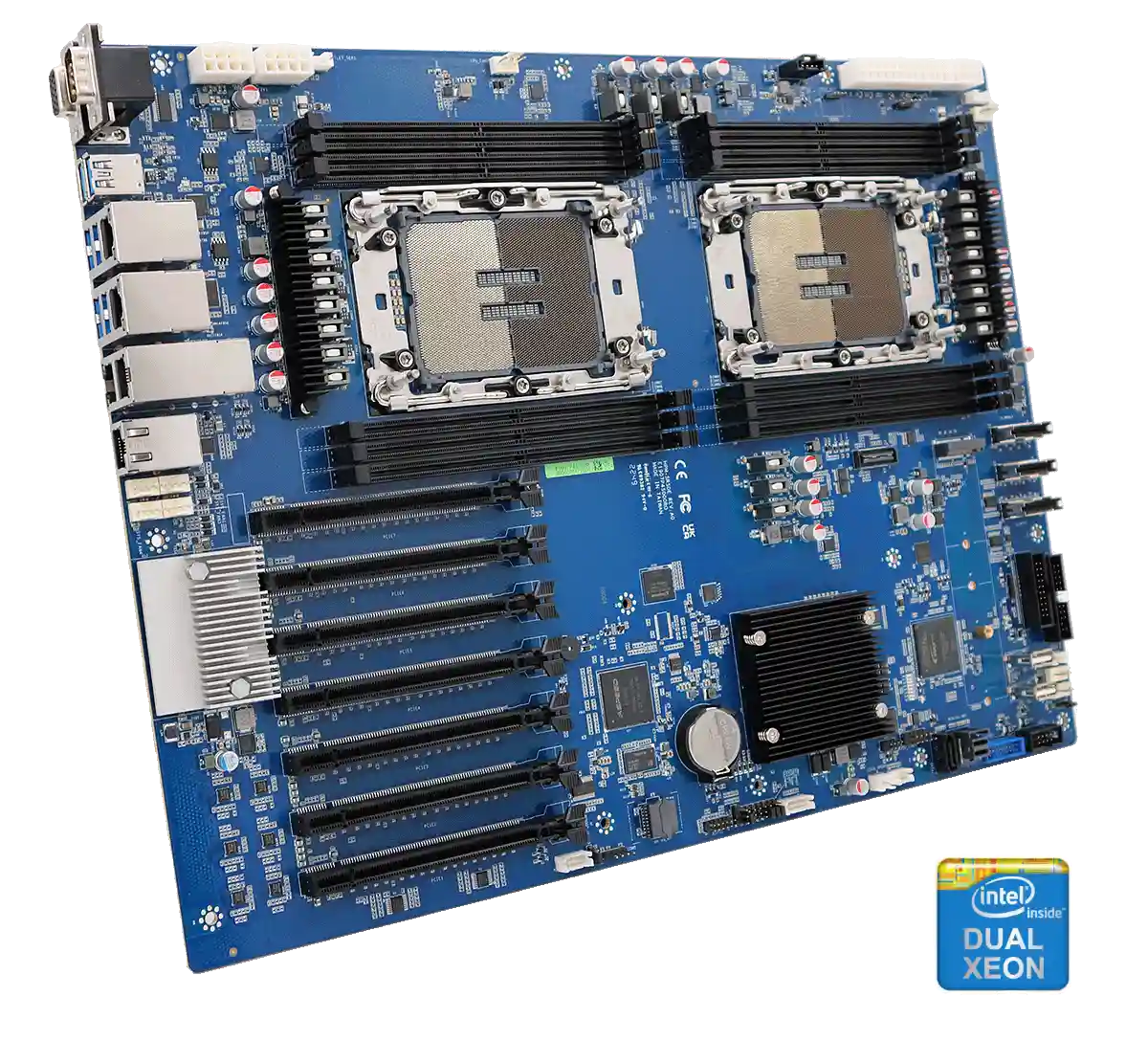
Enterprise data centers utilize a dual-socket motherboard to physically house two processors. This NUMA (Non-Uniform Memory Access) architecture essentially doubles the total core count, expands available PCIe lanes to 160 for multi-GPU setups, and doubles the memory channels, allowing the server to address up to 2TB of ECC RAM for massive parallel workloads.
A dual processor dedicated server is engineered for workloads requiring immense compute density. This includes heavy virtualization (running dozens of Proxmox or VMware ESXi virtual machines), large-scale SQL databases, Big Data analytics, and AI inference tasks utilizing Intel DL Boost and Advanced Matrix Extensions (AMX).
Yes. A dual xeon server motherboard provides the massive PCIe lane bandwidth required to support a dual GPU server configuration without I/O bottlenecks. This makes it the ultimate foundation for deploying vLLM, machine learning models, and heavy 3D rendering pipelines directly on bare metal.
Absolutely. Every bare metal server is provisioned with full root and administrator privileges. You also receive dedicated Out-of-Band management (IPMI / iDRAC) access, giving you BIOS-level control to install custom operating systems, configure NVMe RAID arrays, and manage your dual socket infrastructure securely.
By default, our enterprise bare metal servers are unmanaged at the software level. However, we provide 24/7/365 live technical support for network and hardware infrastructure. If a physical component fails, our on-site data center engineers guarantee rapid hardware replacement to ensure your server maintains maximum uptime.
We offer flexible billing cycles for enterprise clients. You can pay for your dedicated server using major Credit Cards (Visa, MasterCard, Amex) as well as secure cryptocurrency options including Bitcoin (BTC) and USDT (TRC20).
A quad xeon dedicated server houses four physical processors in a single chassis. It is designed for extreme enterprise workloads, such as SAP HANA in-memory databases, where processing massive datasets entirely in RAM across hundreds of CPU threads is required with absolutely zero network latency between nodes.