What is NVIDIA RTX 6000 Blackwell?
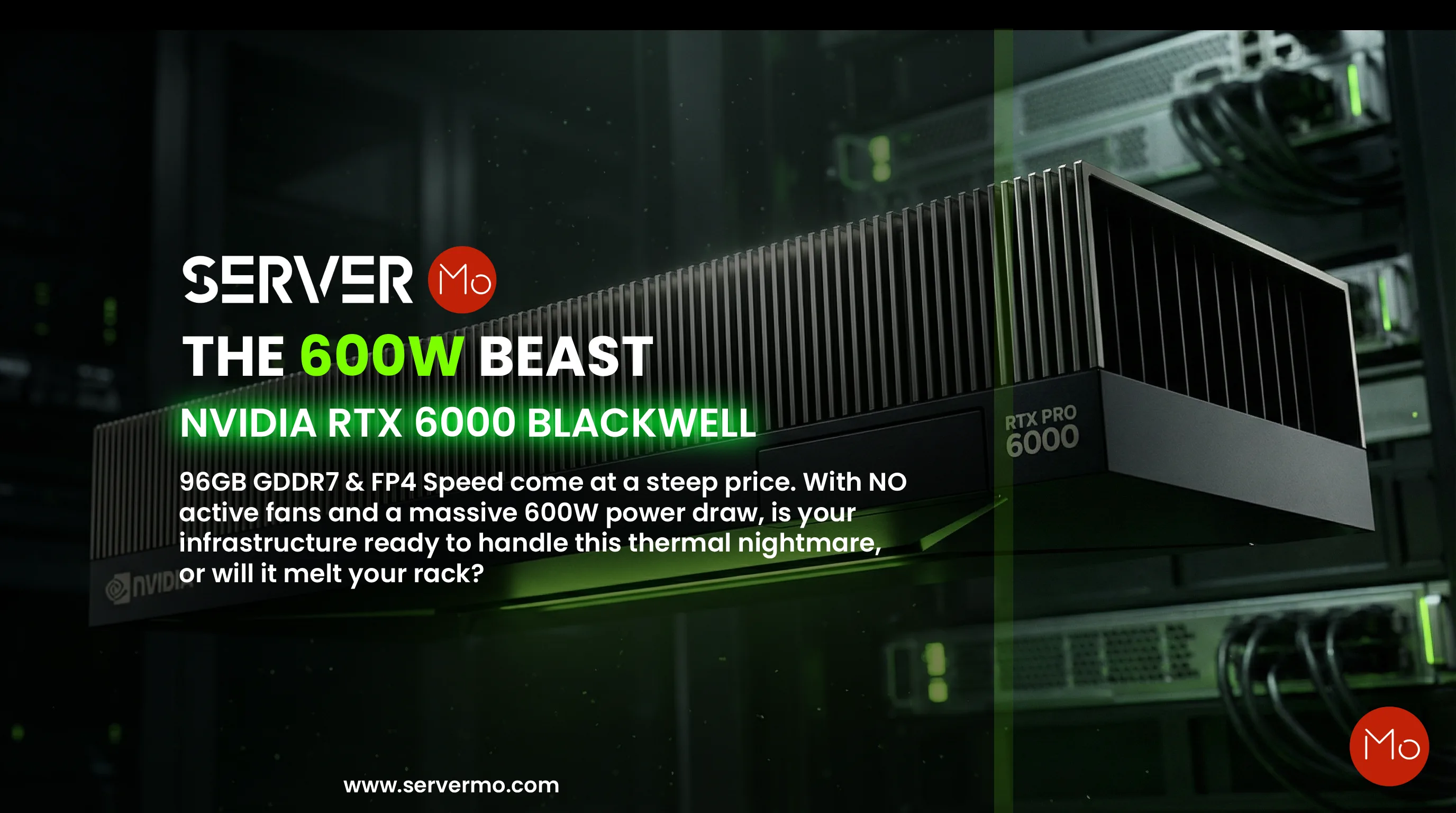
The NVIDIA RTX 6000 Blackwell Server Edition is the direct successor to the RTX 6000 Ada Generation. Built on the cutting-edge Blackwell Architecture (GB202), it is a professional dual-slot GPU designed specifically for Data Centers.
Unlike consumer cards (GeForce) or Training chips (H100), this card hits the "Sweet Spot" for AI Inference, 3D Rendering, and Omniverse Digital Twins. It combines massive 96GB GDDR7 VRAM with enterprise reliability.
Beyond the Marketing: The Real Blackwell Story
While NVIDIA marketing focuses on "Universal AI," we dug deeper. We analyzed technical datasheets from Lenovo, Supermicro, PNY, and TechPowerUp to build the most comprehensive guide on the internet for the NVIDIA RTX 6000 Blackwell Server Edition.
This isn't just an upgrade; it's a complete architecture overhaul based on the GB202 Chip. With 92.2 Billion transistors and a massive 600W TDP, this card bridges the gap between the workstation and the data center H100s.
Quick Verdict:
If you are training "Agentic AI" or running large-scale rendering farms, this card offers 5x the Inference Performance of the L40S. But be warned: the power and cooling requirements are drastic.
Hardware Deep Dive: What's Inside the Beast?
Forget the glossy brochures. Here are the raw numbers sourced from TechPowerUp and official PNY datasheets, presented in our technical breakdown:
Reality Check #1: The 600W Thermal Anomaly
Official spec sheets state: "Max Power Consumption: Up to 600W (Configurable)." This is where things get tricky.
SysAdmin Reality Check: The Thermal Nightmare
- The Claim: 600W TDP with Passive Cooling.
- The Anomaly: Dissipating 600W of heat without active fans on the card is a physics challenge. If you put 8 of these in a rack (4.8kW Total), standard server fans might struggle.
- Our Analysis: The "600W" figure likely refers to peak spike limit or requires extreme airflow. For standard air-cooled servers, this card will likely be power-capped (throttled) to 350W-450W (Unless you have Liquid Cooling) to prevent thermal shutdown. Do not put this in a standard workstation.
Memory Revolution: GDDR7 Arrives
This is the world's first professional GPU to utilize GDDR7 memory. Why does this matter?
Bandwidth is King:
Previous generation cards (Ada) peaked at 960 GB/s. The RTX 6000 Blackwell hits
1597 GB/s (approx 1.6 TB/s). In AI training, bandwidth determines how fast
you can feed data to the cores. This massive pipe eliminates bottlenecks for Large
Language Models (LLMs).
Reality Check #2: H100 Killer or Alternative?
Let's stop the "Killer" narrative. It's mathematically impossible for this card to beat an H100 in training.
| Spec | NVIDIA H100 (The King) | RTX 6000 Blackwell | The Reality |
|---|---|---|---|
| Memory Bandwidth | 3.35 TB/s (HBM3) | ~1.6 TB/s (GDDR7) | H100 is 2x Faster for Training data movement. |
| Interconnect | NVLink (900 GB/s) | PCIe Gen 5 (128 GB/s) | H100 clusters scale better. RTX relies on slower PCIe. |
| FP64 (Scientific) | 34 TFLOPS | Reduced / Capped | NVIDIA limits FP64 on RTX cards to protect H100 sales. |
| The Verdict | Training Powerhouse | Inference King | Buy RTX 6000 for running AI (Inference), not building it from scratch (Training). |
The "Hidden" Specs: Deployment Reality
We analyzed the Lenovo ThinkSystem and Supermicro integration guides. Here are the critical deployment factors competitors often hide:
- DisplayPorts Disabled:
Lenovo documentation confirms: "4x DisplayPort 2.1b (disabled by default)". This is a headless compute engine, not a display driver. - New Power Connectors:
Requires the new 16-pin PCIe CEM5 connector. Old PSUs will not work. - System RAM Requirement:
PNY datasheets recommend: "System memory should be greater than or equal to GPU memory, ideally twice the GPU memory." For an 8-GPU setup (768GB VRAM), your server needs at least 1.5 TB of System RAM to prevent bottlenecks.
Performance: The FP4 Advantage
The biggest selling point is FP4 Precision. The 5th Gen Tensor Cores can process 4-bit floating-point data.
- Inference Speed: 4 PFLOPS (Peak FP4).
- Model Size: You can run models twice as large in the same 96GB memory footprint compared to FP8.
- L40S Comparison: Up to 5x faster for LLM inference and Agentic AI workloads.
- Genomics: 7x faster sequencing analysis compared to L40S.
Relative Performance (TechPowerUp Data)
How does it stack up against consumer heavyweights? Based on architecture and shader count estimations:
| GPU Model | Relative Performance |
|---|---|
| RTX 6000 Blackwell | 100% |
| GeForce RTX 5090 | 83% |
| GeForce RTX 4090 | 63% |
| RTX 6000 Ada | ~65% |
RTX 6000 Blackwell Technical FAQ
The card has a maximum power consumption (TDP) of 600W. This is a significant increase from the previous generation's 300W, requiring specialized power delivery (PCIe CEM5 16-pin) and high-density cooling infrastructure.
Yes. It features 5th Gen Tensor Cores with native FP4 support, delivering up to 4 PFLOPS of AI performance. This allows for faster inference of large language models compared to FP8 or FP16 by effectively doubling the model capacity in VRAM.
The RTX 6000 Blackwell features 96GB of GDDR7 memory with a bandwidth of 1597 GB/s (approximately 1.6 TB/s). This is nearly double the bandwidth of previous GDDR6 workstation cards, eliminating data feeding bottlenecks.
According to Lenovo and NVIDIA documentation, the Server Edition comes with 4x DisplayPort 2.1b connectors, but they are typically disabled by default to prioritize headless server operation and maximize compute resources for AI and rendering.
 Your Voice Matters: Share Your Thoughts Below!
 Recent Topics for you