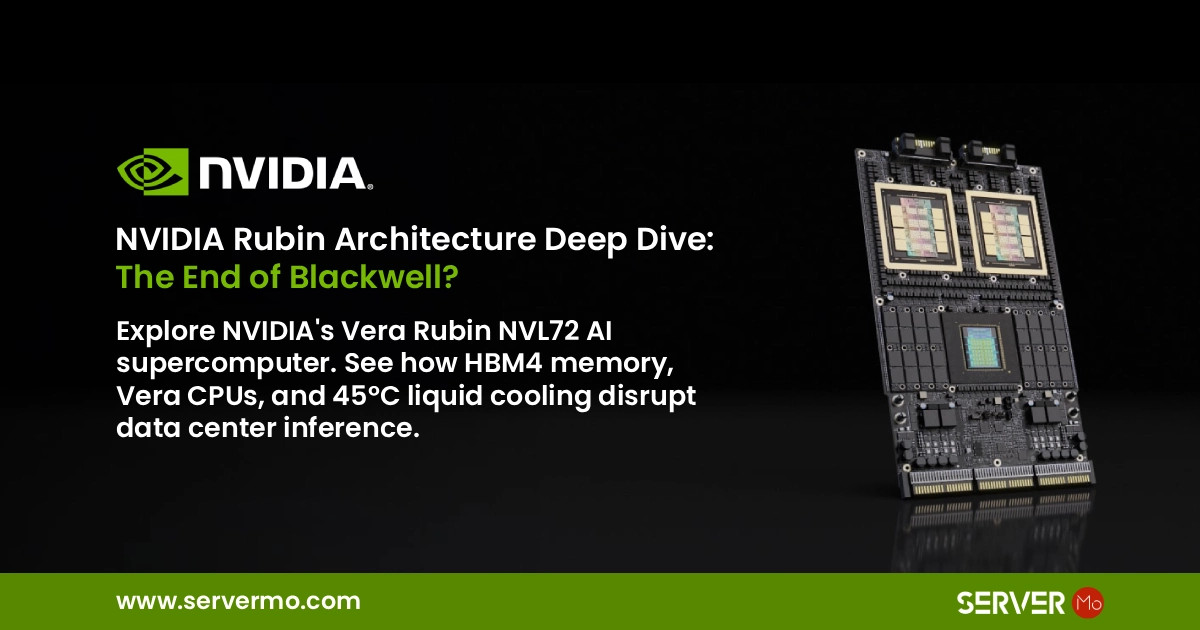
The ink on Blackwell orders hasn't even dried, yet the tech world is already bracing for the next tectonic shift. At CES 2026, CEO Jensen Huang made it official: The NVIDIA Rubin Architecture is in full production. This announcement effectively sparked a $500 Billion infrastructure supercycle among the "Big Five" hyperscalers.
Why the rush? Because the AI era is no longer about just training chatbots. It is about Agentic AI—systems that reason, plan, and execute multi-step workflows. This requires an entirely new breed of infrastructure. Welcome to the era of Vera Rubin.
The Death of the "Compute First" Era
For years, the industry measured GPUs by raw FLOPs. Rubin changes the paradigm. As AI models shift to massive Mixture-of-Experts (MoE) architectures and long-context reasoning, data movement has become the primary bottleneck. Rubin is not a "compute-first" chip; it is a network-first and memory-first supercomputer designed to shatter the memory wall.
Hardware Deep Dive: The Six-Chip Ecosystem
Rubin is not a single GPU. It is an extreme co-design of six specialized chips working in perfect harmony, manufactured on a custom TSMC 3nm-class process. Here is the complete arsenal inside the NVL72 rack:
This combination completely shatters the "Memory Wall." The CPU, GPU, and DPU all communicate instantly, allowing massive Mixture-of-Experts (MoE) models to process multi-step Agentic AI workflows without waiting for data to load.
1. The Rubin GPU & HBM4 Memory
The Rubin GPU introduces a 3rd-generation Transformer Engine that delivers an earth-shattering 50 PetaFLOPS of NVFP4 (4-bit) inference performance—a 5x leap over Blackwell. But the real star of the show is the memory.
Rubin is the first architecture to utilize HBM4 memory, delivering 22 TB/s of memory bandwidth per GPU (a 2.8x increase over Blackwell's 8 TB/s). This massive pipe is exactly what is needed to feed tokens into Agentic AI models without stalling the compute cores.
2. The Vera CPU (ARM's Revenge)
Say goodbye to the Grace CPU. The new NVIDIA Vera CPU packs 88 custom Olympus cores. Equipped with 1.5 TB of on-chip LPDDR5X memory yielding 1.2 TB/s bandwidth, it acts as the ultimate traffic director for AI factories. It links to the GPU via a 1.8 TB/s NVLink-C2C connection, ensuring the CPU and GPU share a coherent memory pool.
3. NVLink 6: 3.6 TB/s Interconnect
To train MoE models efficiently, GPUs must talk to each other instantly. NVLink 6 doubles Blackwell's performance, providing 3.6 TB/s of all-to-all scale-up bandwidth per GPU. When racked up in the Vera Rubin NVL72 configuration, the internal network pushes 260 TB/s—more bandwidth than the entire global internet.
The HVAC Nightmare: 45°C Hot Water Cooling
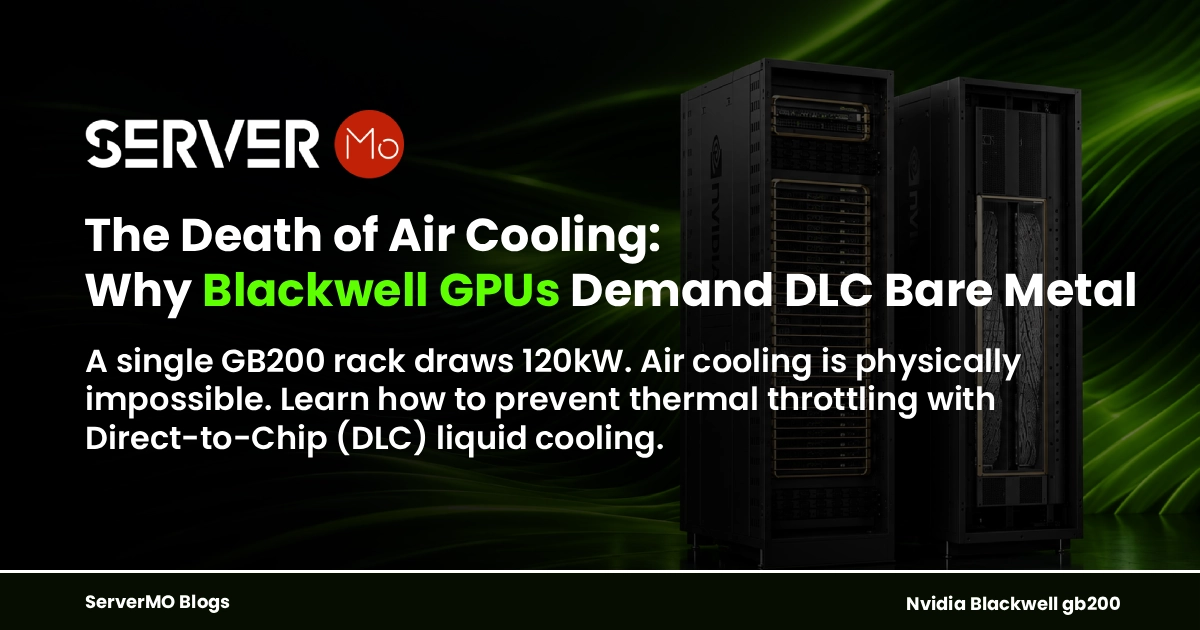
Perhaps the most disruptive announcement at CES wasn't about silicon, but water. The Vera Rubin NVL72 rack represents a massive leap in power density, doubling the power consumption of Grace Blackwell.
The End of Traditional Data Centers
- The Innovation: NVIDIA announced that Rubin can be cooled using water as warm as 45°C (113°F) using single-phase Direct Liquid Cooling (DLC).
- The Market Shock: This eliminates the need for power-hungry mechanical chillers. Following the announcement, stocks of major HVAC and cooling companies (Johnson Controls, Modine, Trane) plummeted by 5% to 21%.
- The Infrastructure Reality: You cannot put a Rubin rack in a traditional air-cooled colocation facility. The NVL72 is fanless, tubeless, and cableless inside the rack. If your hosting provider isn't ready for advanced liquid cooling, you cannot run Rubin.
Blackwell vs. Rubin: The Spec Showdown
Is Rubin an evolutionary step, or a completely new species? Let's look at the numbers.
| Feature | NVIDIA Blackwell (B200) | NVIDIA Rubin (R200) | The Rubin Advantage |
|---|---|---|---|
| Process Node | TSMC 4NP | TSMC 3nm-class | Higher transistor density & efficiency |
| Memory Tech | HBM3e | HBM4 | Shatters the "Memory Wall" |
| Memory Bandwidth | 8 TB/s | 22 TB/s | 2.8x Faster data feeding |
| Inference Compute (FP4) | 10 PFLOPS | 50 PFLOPS | 5x Faster Agentic AI execution |
| GPU Interconnect | NVLink 5 (1.8 TB/s) | NVLink 6 (3.6 TB/s) | 2x Bandwidth for MoE clusters |
| Inference Economics | Baseline | 10x Lower Token Cost | Massive ROI for API providers |
The Economic Verdict: 10x Lower Token Cost
For AI startups and enterprise developers, the most important metric isn't PetaFLOPS; it's the Cost per Token. By utilizing hardware-accelerated adaptive compression and the new NVFP4 Transformer Engine, the Rubin platform delivers up to a 10x reduction in inference token generation costs compared to Blackwell.
For training, Rubin requires 4x fewer GPUs to train massive Mixture-of-Experts (MoE) models over a fixed timeframe. This fundamentally alters the unit economics of Artificial Intelligence, separating the "AI tourists" from sustainable, profitable AI businesses.
NVIDIA Rubin Technical FAQ
NVIDIA Rubin is the successor to the Blackwell architecture, designed specifically for Agentic AI and deep reasoning workloads. It introduces HBM4 memory, the new Arm-based Vera CPU, NVLink 6, and delivers 5x the inference performance of Blackwell.
The Rubin NVL72 racks use single-phase direct liquid cooling (DLC) with water as warm as 45°C (113°F). This eliminates the need for expensive, power-hungry chillers, reducing data center cooling energy consumption by up to 30%.
HBM4 in the Rubin GPU delivers a massive 22 TB/s of memory bandwidth, which is a 2.8x increase over Blackwell. This effectively shatters the "memory wall", allowing Large Language Models (LLMs) to load and process data much faster without bottlenecking the compute cores.
The Vera CPU is NVIDIA's custom Arm-based processor featuring 88 Olympus cores. Designed to replace the Grace CPU, it offers 1.2 TB/s of LPDDR5X memory bandwidth and communicates with the Rubin GPU via a lightning-fast 1.8 TB/s NVLink-C2C connection.
 Your Voice Matters: Share Your Thoughts Below!
 Recent Topics for you