Entry-Level Edge
For API caching & images.
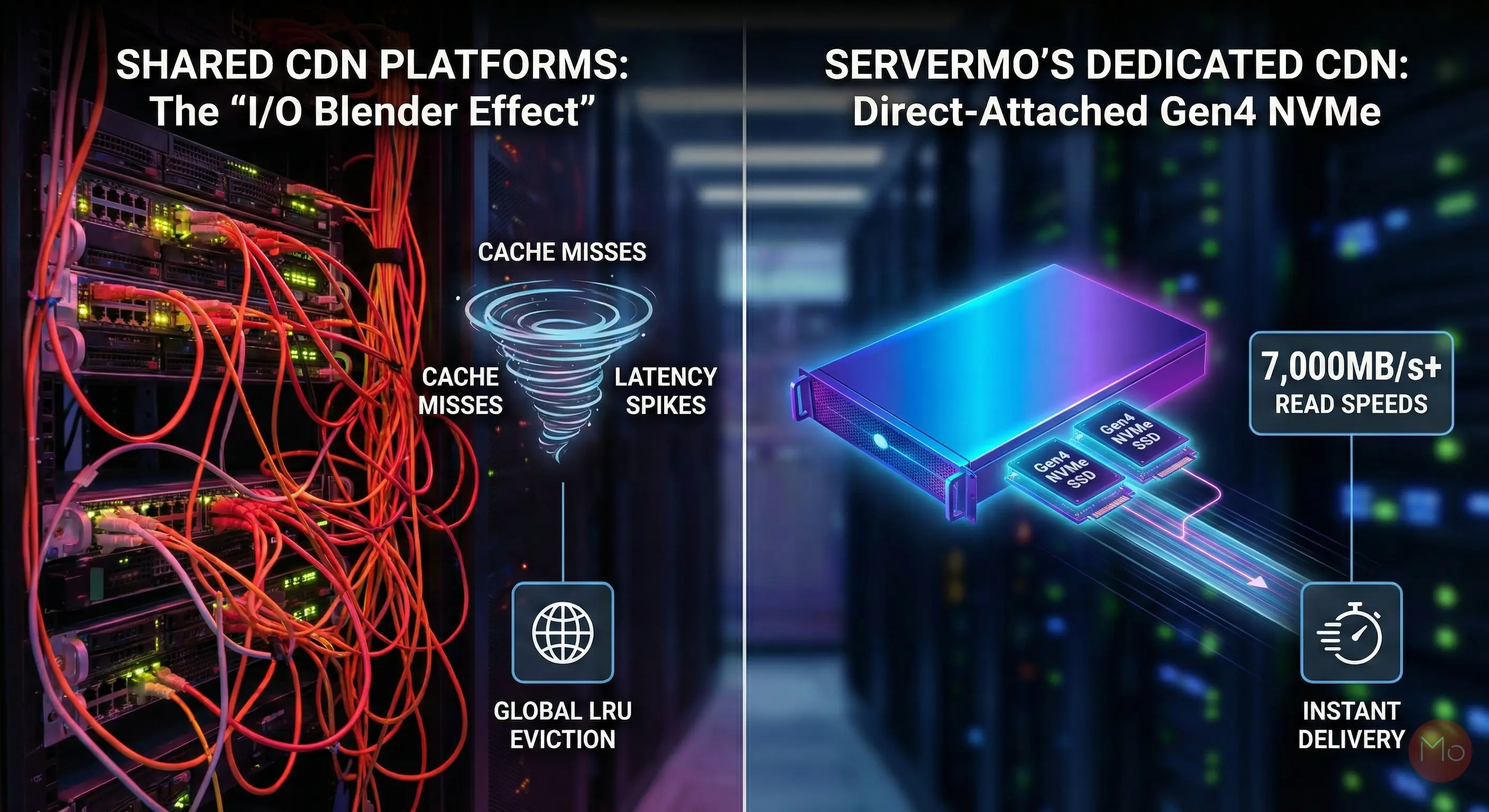
1Gbps Unmetered →Standard CDNs use Global LRU (Least Recently Used) eviction. This means your "cold" assets are frequently purged to make room for other customers, causing slow Cache Misses.
Furthermore, virtualized clouds suffer from the "I/O Blender Effect". When 100+ instances share disk bandwidth, latency spikes occur. ServerMO’s Dedicated CDN Servers solve this with Direct-Attached Gen4 NVMe storage, ensuring 7,000MB/s+ read speeds for instant content delivery.
Deploying your own CDN infrastructure on Bare Metal gives you unmatched performance, but it requires a strategic technical setup. This is the blueprint to ensure your edge nodes operate at maximum efficiency with zero bottlenecks.
To achieve sub-second content delivery, you must optimize how your server interacts with the global internet.

Switching to Google’s BBR algorithm on Bare Metal allows your CDN to reach higher throughput and lower latency over congested long-haul networks.

Unlike public CDNs, you define the Least Recently Used eviction rules. Keep your "hero" assets in the cache longer to boost Hit Ratios.

Enable the fastest encryption protocols. Reduce the time taken for the initial connection between your users and the edge node.
Standard OS limits are not enough for a CDN. When handling 100,000+ concurrent users, you must increase the uLimit and fs.file-max parameters. On our Bare Metal, you have full root access to tune these kernel settings, preventing the dreaded "Too many open files" errors during traffic spikes.
Take your CDN to the enterprise level by announcing your own IP space (BYOIP) via BGP. This allows you to use a single IP address globally. Our network engineers will assist you in peering, ensuring that user requests are automatically routed to the nearest ServerMO edge node for the lowest possible TTFB.
Public CDNs brag about 300+ locations, but each location shares resources among thousands of tenants. With ServerMO, you don't need 300 weak points; you need Strategic Power Nodes.
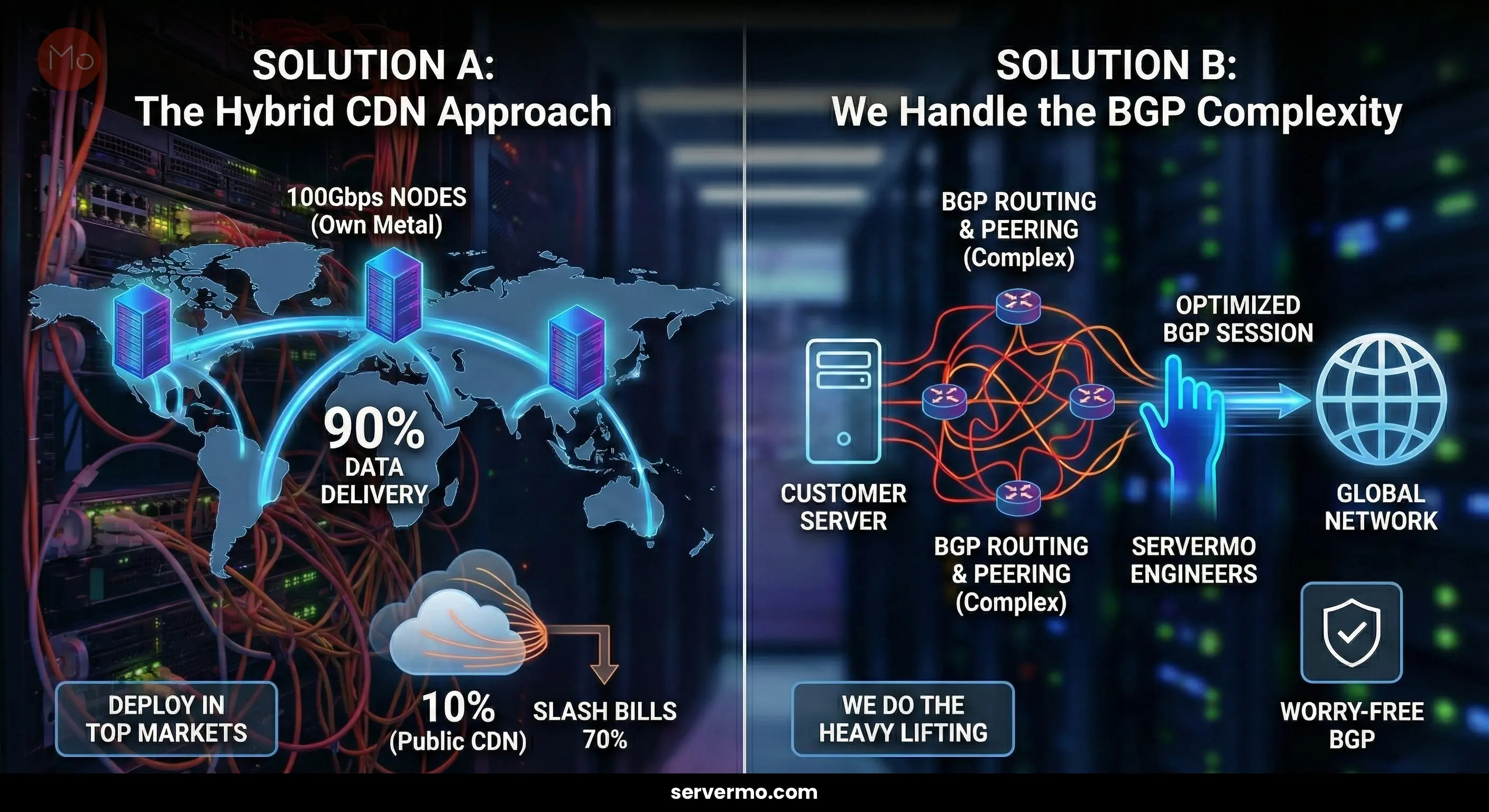
The Strategy: Use our 100Gbps unmetered servers in high-traffic regions (like USA, Europe, or Singapore) to handle your primary data load. For remote regions with minimal traffic, you can maintain a light-weight public CDN layer. This "Edge Tiering" approach gives you the best of both worlds: 100% hardware control where it matters, and global reach where it’s needed—all while cutting costs by 70%.
You don't need 50 servers globally to start. Most traffic comes from specific regions. By deploying High-Capacity 100Gbps nodes in your top-performing markets, you can handle 90% of your data delivery on your own metal, slashing your public CDN bills by up to 70%.
Worried about BGP routing? You don't need a PhD in networking. When you choose our BGP Session Dedicated Servers, our engineers will help you with the announcement and peering setup. We do the heavy lifting, you get the performance.

The industry standard for HTTP acceleration. Perfect for Static Asset Caching. Fine-tune your VCL logic to maximize cache-hit ratios on our NVMe drives.

A comprehensive CDN Management System. It provides a centralized web-based dashboard to manage clusters, WAF rules, and automated SSL across all nodes.

The developer's choice for Programmable Edge. Leverages Nginx + Lua to build high-concurrency dynamic caching and custom request-handling logic.
Building a Telecom-Grade CDN? This open-source tool allows you to build and operate a large-scale CDN similar to Netflix's Open Connect.

The backbone of Video Re-distribution. Efficiently handle RTMP, HLS, and WebRTC streams at the edge with 100Gbps throughput.
The industry gold standard for high-performance BGP routing. BIRD is incredibly lightweight and optimized for speed, making it the preferred choice for massive Anycast networks and internet exchange points.

A full-featured IP routing protocol suite for Linux. Unlike BIRD, FRR provides a Cisco-like CLI (vtysh), making it easier for traditional network engineers to manage BGP, OSPF, and IS-IS on our bare metal.

Use Prometheus & Grafana to monitor real-time metrics, bandwidth utilization, and server health across your entire global edge network.

A mid-sized streaming service was spending $12,000/month on public CDN egress fees. By transitioning to a hybrid model with 4 ServerMO 100Gbps Dedicated Nodes in the USA and Europe, they slashed their bill to $3,400/month.
Full optimization for Varnish Cache Plus and GoEdge. Build advanced VCL logic and manage your cluster through a centralized dashboard with WAF.
The ultimate combo for Video Re-distribution. Low-latency HLS, RTMP, and WebRTC streaming powered by unthrottled 100Gbps uplinks.
Implement BGP Anycast using professional routing daemons. Bring your own IP (BYOIP) and announce prefixes across our global network fabric.
Scale to Telecom-Grade levels with Apache Traffic Control. Monitor real-time edge performance and bandwidth with the Prometheus/Grafana stack.
For API caching & images.
1Gbps Unmetered →For 4K VOD & Live Sports.
10Gbps | 20Gbps | 40Gbps →For Global OTT Platforms.
100Gbps Dedicated →For CDN nodes, a dedicated IP ensures your Anycast routing and SSL certificates are tied exclusively to your hardware. Unlike shared IPs, you have total control over the reputation and routing path of your content delivery.
Anycast is a networking technique where the same IP address is announced from multiple global locations simultaneously via BGP (Border Gateway Protocol).
For your CDN, this means a user in Singapore will automatically connect to your Singapore node, while a user in London connects to your UK node—all using the same single IP. This drastically reduces Latency (TTFB) and provides High Availability; if one node fails, traffic is instantly re-routed to the next closest healthy node without any DNS changes.
Standard CDN setups fetch content over the congested public internet, leading to slow Cache Filling. At ServerMO, we provide Private Networking (VLAN) capabilities across our nodes.
By leveraging our unthrottled 10Gbps to 100Gbps internal pipes, you can configure a private back-haul between your Origin and Edge nodes. This ensures your cache is populated at wire speed, bypassing public ISP congestion and significantly reducing the load on your origin server.
Absolutely Zero. We’ve abolished the "Success Tax." Public cloud CDNs penalize your growth by charging per-GB Egress Fees—the more successful you become, the more they bleed your margins.
At ServerMO, we offer Bandwidth Sovereignty. You pay a single, flat monthly fee for the physical capacity of your port (10Gbps to 100Gbps). Whether you push 100 Terabytes or 10 Petabytes, your bill never changes. No hidden meters, no bandwidth caps, and zero bill-shock. Just pure, unthrottled power.
Our enterprise-grade scrubbing centers mitigate volumetric attacks at the edge. By the time traffic reaches your CDN node, it has already been filtered, ensuring your delivery service remains online even during massive attacks.
Absolutely. You have full root access. You can install and optimize any stack, including Varnish Cache, OpenResty, NGINX-RTMP, or Apache Traffic Control, and tune the OS kernel to your specific needs.



Power. Performance. Precision.
Unwrap the ultimate power! Get massive holiday discounts on all Dedicated Servers. Offer ends soon grab yours before the snow melts!