Massive Storage Density
Store Petabytes of data cost-effectively. Choose servers with 100TB+ of Raw Storage (High-Capacity HDDs) for Data Lakes, or Ultra-fast NVMe for real-time analytics.
Scaling Big Data on the public cloud (like AWS EMR or Google Dataproc) is easy to start but impossible to sustain.
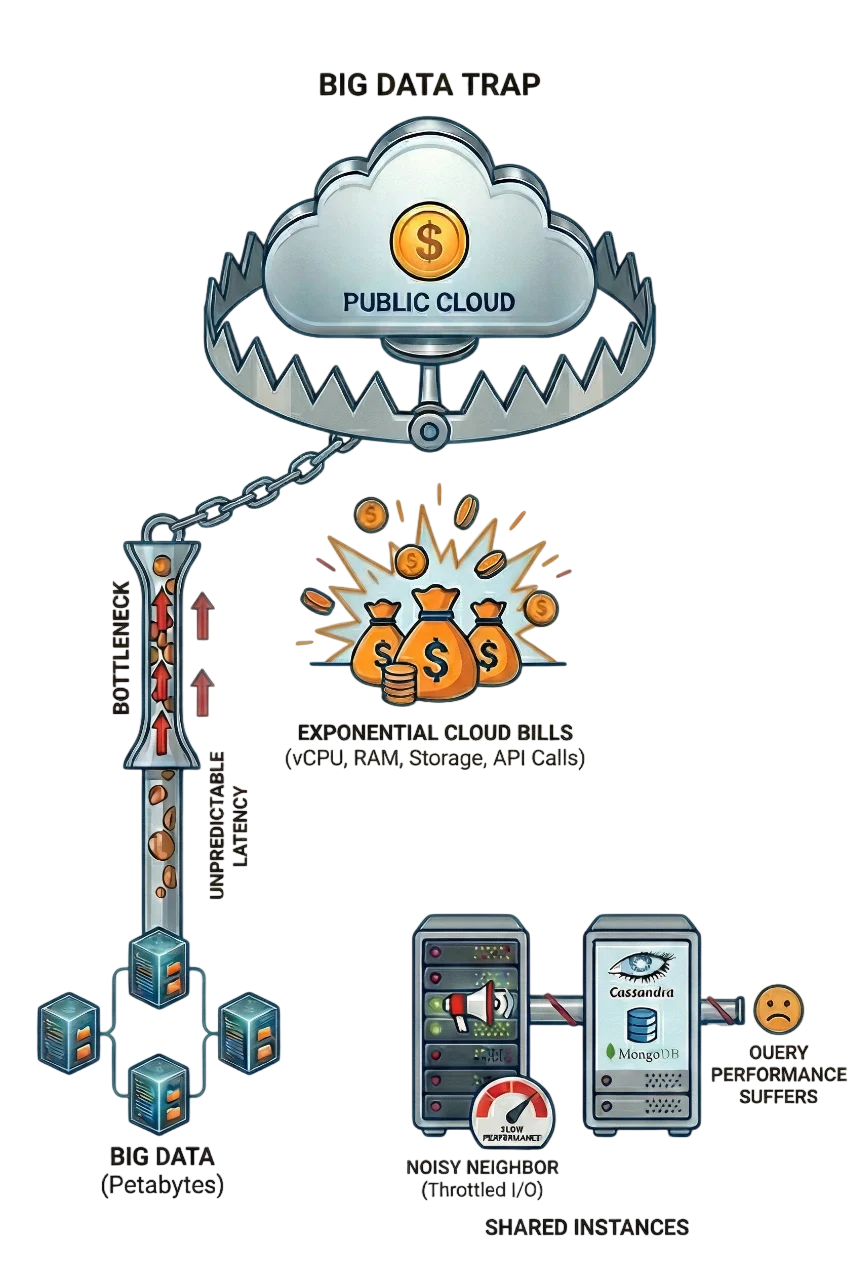
We provide the dedicated physical infrastructure you need to build a high-performance, predictable, and cost-effective data platform.
Store Petabytes of data cost-effectively. Choose servers with 100TB+ of Raw Storage (High-Capacity HDDs) for Data Lakes, or Ultra-fast NVMe for real-time analytics.

Cluster communication is critical. We provide a dedicated, unmetered private network(with 1Gbps, 10Gbps, 20Gbps, 40Gbps, or 100Gbps options) to handle massive data shuffling between nodes with near-zero latency and no per-GB traffic fees.

Don't get locked into fixed "Instance Types." You choose the exact CPU-to-RAM ratio you need. Need 1TB RAM with a specific CPU for an In-Memory Spark cluster? We can build it.

You are the architect. Install any stack you want—Cloudera, Hortonworks, or pure Open Source Apache versions. Tweak the OS kernel parameters to optimize file system performance (ext4/xfs) for your specific workload.
Our bare metal servers provide the perfect foundation for the world's leading data technologies.

Build a scalable Data Lake with high-density HDD servers. Use our private network for fast replication and MapReduce jobs.
Run lightning-fast in-memory processing. Our high-RAM servers (up to 2TB RAM) eliminate bottlenecks for iterative algorithms and machine learning.

Handle millions of events per second. Our NVMe storage ensures low-latency message persistence and high throughput for your streaming pipelines.
Get the consistent low-latency read/write performance your application needs with dedicated NVMe storage and no "noisy neighbor" interference.
Run the ELK Stack at scale. Our high-frequency CPUs and NVMe storage eliminate indexing bottlenecks, allowing you to ingest and search terabytes of logs in real-time.
Deploy fault-tolerant enterprise search. Our high-RAM servers ensure your working set stays in memory for millisecond query responses, even with massive distributed indices.

Process billions of rows per second. Our bare metal servers provide the raw CPU power required for ClickHouse's vectorized query execution and efficient columnar compression.
Power real-time analytics dashboards. Get the low-latency ingestion and sub-second query performance needed for interactive data exploration and high-concurrency streaming analytics.
A "one-size-fits-all" server doesn't work for Big Data. We recommend specific architectures for different node types.
Process millions of transactions in milliseconds using in-memory Spark clusters to detect fraud in real-time.
Handle massive streams of bid requests with ultra-low latency NoSQL databases like Aerospike or ScyllaDB.
Ingest and process terabytes of sensor data from millions of devices using Kafka and Hadoop.
Analyze massive genomic datasets securely on single-tenant hardware, ensuring HIPAA compliance and data sovereignty.
Yes.This is critical for Big Data shuffling. We provide a private VLAN that connects all your servers. This traffic is completely unmetered(no bandwidth usage caps). We offer 1Gbps, 10Gbps, and even 25Gbps private networking options to ensure your "Shuffle" phase never bottlenecks.
Yes. This is a standard Tiered Storageconfiguration for Hadoop. You can use NVMe drivesfor the OS and "Scratch" space (intermediate data) to speed up processing/shuffling, while using high-capacity Enterprise HDDsfor HDFS data storage. This gives you the best balance of speed and cost per TB.
Predictable Cost & Better Performance.With AWS EMR, you pay an extra fee on top of the EC2 cost, plus expensive egress fees. With ServerMO, you pay a flat monthly feefor the hardware. Since there is no hypervisor overhead (virtualization), your jobs typically run 20-30% fasteron bare metal due to direct hardware access.
No. We provide the Unmanaged Bare Metalinfrastructure. You have full root access to install and configure your own stack (e.g., Cloudera, Hortonworks, or vanilla Apache). This ensures you have no vendor lock-inand absolute control over your data security and versioning.
Generally, No.HDFS (Hadoop Distributed File System) manages data redundancy by replicating blocks across different servers (usually 3x replication). Using RAID 0/5/10 on the hardware level is often redundant and reduces write performance. We recommend presenting disks as JBOD (Just a Bunch Of Disks)for HDFS Datanodes. However, for the OS drive or NoSQL databases (MongoDB/Cassandra), RAID is highly recommended.
Yes. For extreme data ingestion (like Kafka or Spark Streaming), network bandwidth is often the bottleneck. We support LACP (Link Aggregation Control Protocol)(802.3ad). We can bond two 10Gbps ports to give your server a massive 20Gbps dedicated pipe, ensuring your node can ingest streams without dropped packets.
Kafka relies heavily on Sequential Disk I/Oand Page Cache. We recommend:
In a virtualized cloud, you don't control which physical RAM stick your VM accesses, creating latency. On ServerMO bare metal, you have full visibility into the NUMA (Non-Uniform Memory Access)topology. You can pin your Spark executors or Redis instances to specific CPU cores and local memory banks. This massive reduction in memory latency significantly boosts performance for in-memory processing.
For write-heavy NoSQL databases, the "Commit Log" is the bottleneck. We recommend a Split Storage Strategy:
Yes. Many clients use our High-Density HDD servers to run MinIOor Ceph Object Gateway. This gives you a private, S3-compatible object storage layer that costs a fraction of AWS S3. You can then point your Spark or Presto/Trino compute nodes (running on separate NVMe servers) to this private Data Lake, creating a high-performance, cost-effective Lakehouse Architecture.



Power. Performance. Precision.
Unwrap the ultimate power! Get massive holiday discounts on all Dedicated Servers. Offer ends soon grab yours before the snow melts!