




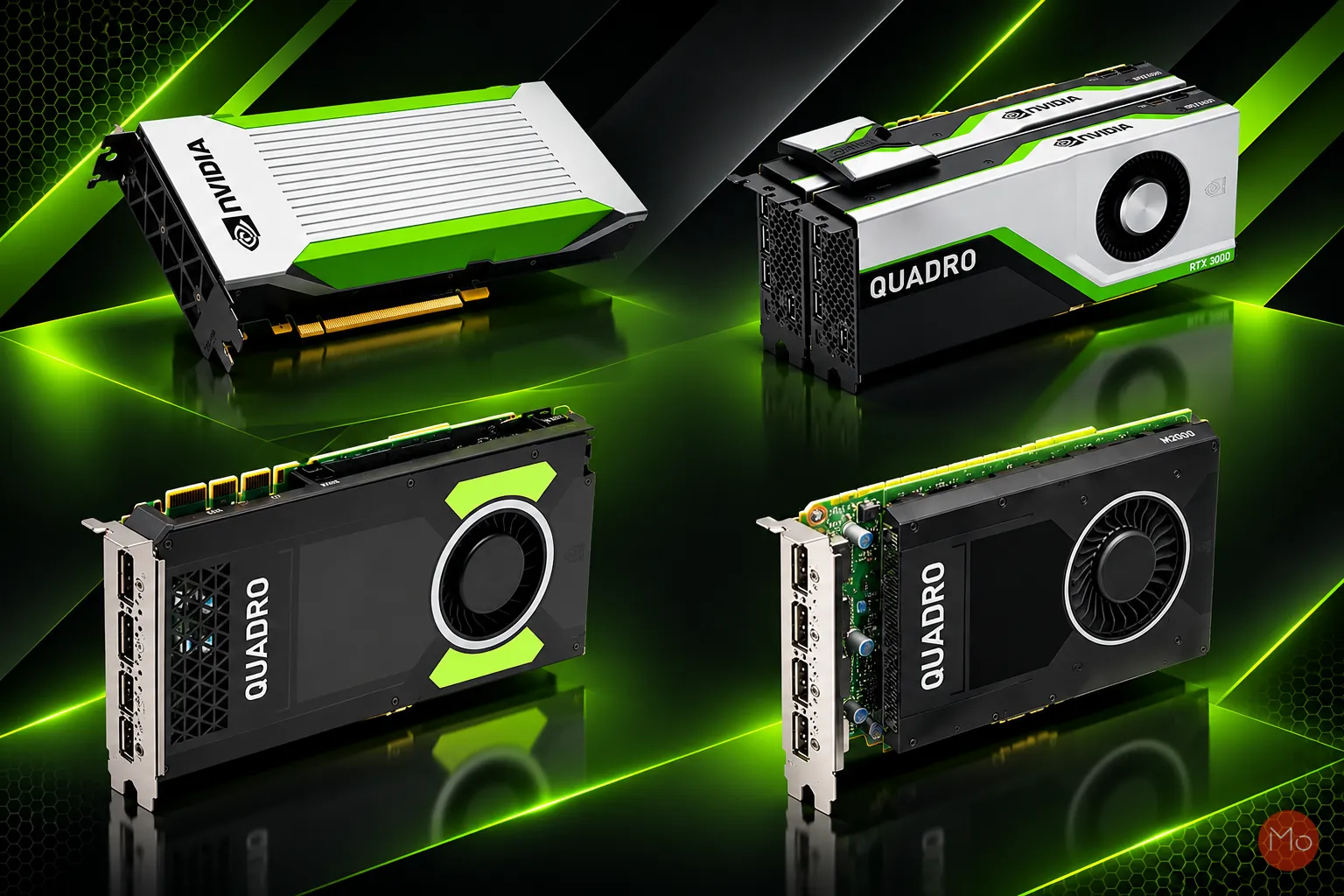
A professional GPU server is a bare-metal physical machine equipped with graphics cards designed for enterprise visual computing, such as the NVIDIA Quadro and RTX A-Series, offering hardware optimized for CAD, VFX, and 3D rendering.
Gaming GPUs (NVIDIA GeForce) are designed primarily for consumer gaming and general graphics workloads. Professional GPUs (Quadro/RTX Pro) are built for precision and stability, featuring professional driver support optimized for CAD and visualization software. Deploying consumer cards commercially requires evaluating driver support, server cooling, and applicable NVIDIA software licensing terms.
NVIDIA Quadro GPUs are professional workstation graphics cards designed for graphics-intensive applications. They can be deployed in compatible dedicated server hardware, subject to the GPU's technical requirements, software compatibility, and applicable licensing terms. Customers planning commercial remote workstation or virtual GPU services should review the relevant NVIDIA software and product-specific licensing requirements before deployment.
Yes, that is their exact purpose. Depending on workload complexity, legacy Quadro cards (like the P2000) may efficiently handle 2D/3D CAD drafting. Modern professional cards (like the RTX 4000) feature dedicated RT Cores that can accelerate supported 3D rendering engines (e.g., Blender, V-Ray).
GPU selection depends on the specific application and workload. For AutoCAD (viewport operations), a P2000 may suffice based on model complexity. For Revit or Maya, selection depends on project size, visualization requirements, and whether the rendering engine supports specific GPU acceleration (e.g., RTX 4000).
It depends entirely on your scene's texture resolution, geometry, and rendering engine. 8GB is sufficient for many architectural visualizations and product designs. However, if a scene exceeds available GPU memory, the application may use system memory, use another rendering path, or fail.
"Quadro" was NVIDIA's legacy brand name for professional graphics cards (e.g., Quadro RTX 4000). NVIDIA transitioned to simply using "NVIDIA RTX" (e.g., RTX 6000 Ada) for newer workstation generations. Both represent the professional workstation family.
Yes. On bare-metal configurations that provide full root and administrator access, you are free to install your preferred operating system and the specific NVIDIA driver branch required by your software compatibility matrix.
Yes. You can access the server's hardware controls via IPMI (for power and hardware monitoring) and SSH/RDP for OS access. For remote graphics workflows, you must install supported remote workstation protocols (like Parsec or NICE DCV) and verify their specific licensing.
ServerMO provides the physical GPU hardware and dedicated server infrastructure. NVIDIA software licensing depends on how the GPU is deployed and used. Assigning a complete physical GPU to a single virtual machine through PCIe passthrough is different from creating shared virtual GPUs using NVIDIA vGPU software. Virtual GPU deployments require the applicable NVIDIA vGPU software licenses. Remote desktop and session-based application deployments may also have separate licensing requirements, depending on the GPU, software, and deployment model. Customers should verify the applicable NVIDIA product-specific licensing terms before implementing GPU virtualization.
Dedicated bare-metal servers are fixed physical configurations. However, depending on the specific chassis and inventory availability, hardware upgrades (RAM/Storage) may be scheduled to scale with your workload.
The Quadro P2000 (Pascal) can be a cost-effective option for supported 2D/3D CAD and lighter visualization workloads. The Quadro RTX 4000 (Turing) offers more GPU memory, higher processing capabilities, RT Cores, and Tensor Cores. It may be a better fit for applications that support its hardware ray-tracing and AI-accelerated features. Your choice should depend on software compatibility, scene complexity, and GPU memory requirements.
Legacy cards like the Quadro K2000D (Kepler) reached their final supported driver branch (R470). You must verify specific software compatibility before deploying, as they are largely strictly for maintaining legacy software environments.
A dedicated GPU server provides exclusive access to physical hardware (bare metal) with predictable monthly pricing. A cloud workstation is typically a virtualized instance running on shared infrastructure (though dedicated cloud instances exist), often billed per hour or per second.