Evaluating pgvector, Pinecone, Redis & PostgreSQL for AI Agent Memory
An SRE guide to production AI architectures: Two-tier agent memory, Hybrid Search, Indexing trade-offs, and when to self-host on Bare Metal.
The debate surrounding pgvector vs Pinecone or Redis vs PostgreSQL often devolves into binary marketing claims. In reality, architecting state and memory for AI agents is not about choosing a single "best" database. It is about understanding operational boundaries, retrieval mechanics, and failure modes at scale.
Production AI agents introduce workload patterns that break standard architectures. They write intermediate reasoning steps, update shared states concurrently, and require both sub-millisecond session retrieval and deep semantic search over billions of vectors. In this engineering guide, we will evaluate the current state of vector databases in 2026, exploring when to decouple state using Redis, when pgvector’s unified architecture wins, and when a dedicated service like Pinecone is the right choice.
When evaluating the postgres pgvector vs pinecone architecture, the most profound difference lies in system boundaries. When relational records and vector records are maintained in separate systems (e.g., app data in Postgres, embeddings in Pinecone), application-level synchronization introduces an additional failure boundary.
If a user deletes their account in your primary database but the subsequent API call to your vector service fails, you create an orphaned vector. By storing vectors natively alongside relational data using pgvector, you guarantee ACID compliance. The text, metadata, and embeddings update or rollback atomically in a single transaction. Furthermore, keeping everything in PostgreSQL allows SREs to leverage mature operational tooling: Point-in-Time Recovery (PITR), robust replication, pg_stat_statements, and Prometheus exporters.
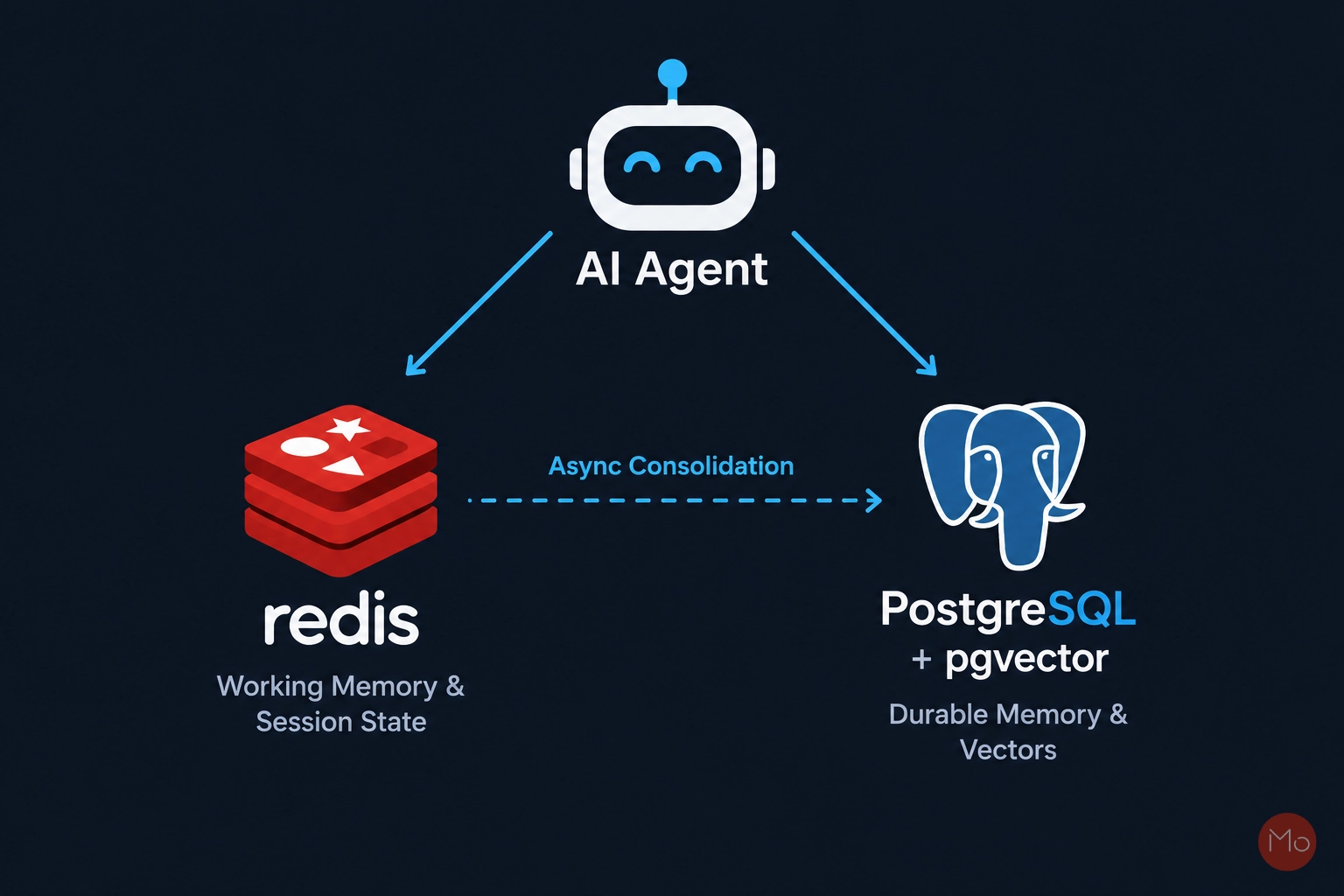
A common anti-pattern is forcing PostgreSQL to handle every transient state update of an active AI agent. Redis has evolved significantly beyond a simple cache. In a modern architecture, Redis supports Streams, semantic caching, TTL-based memory decay, and background summarization.
The industry standard is a two-tier architecture where Redis acts as the hot state layer, while PostgreSQL remains the durable system of record:
Fig 1: The Two-Tier Architecture: Redis for hot state, PostgreSQL for durable memory.
Phase 3: Hybrid Search: Vector + Full Text + SQL
Production RAG demands more than vector similarity. Dense vector search excels at semantic matching but often fails on exact identifiers (e.g., retrieving "Invoice INV-2026-8832"). This requires Hybrid Search.
While dedicated databases like Weaviate offer this natively, PostgreSQL allows you to construct powerful hybrid queries by combining tsvector (BM25 full-text search) with pgvector (cosine similarity), wrapped in a standard SQL Common Table Expression (CTE) to weight and merge the scores.
-- Example: Combining Full-Text Search with Vector Similarity
WITH semantic_search AS (
    SELECT id, 1 - (embedding <=> '[0.1, -0.2...]'::vector) AS semantic_score
    FROM documents
    ORDER BY embedding <=> '[0.1, -0.2...]'::vector LIMIT 20
),
keyword_search AS (
    SELECT id, ts_rank_cd(to_tsvector('english', content), plainto_tsquery('english', 'Invoice 8832')) AS keyword_score
    FROM documents
    WHERE to_tsvector('english', content) @@ plainto_tsquery('english', 'Invoice 8832') LIMIT 20
)
-- Reciprocal Rank Fusion (RRF) logic would follow here to merge scores.
The Filtered ANN Problem: Historically, applying a highly selective SQL WHERE clause before an Approximate Nearest Neighbor (ANN) search caused degraded recall because the index scan would miss filtered results. Current releases of pgvector (0.8+) support iterative index scans, which can continue scanning an approximate index when filtering would otherwise leave too few results, drastically improving retrieval quality.
Multitenancy: In B2B AI SaaS, isolating tenant data is critical. While managed vector DBs use "namespaces", PostgreSQL excels through native features like Row-Level Security (RLS), table partitioning by tenant_id, or separate schemas. This ensures zero data leakage between agent sessions at the database engine layer.
Phase 5: JSONB / Agent Event Storage Discipline
When logging an agent's execution trace to PostgreSQL, developers often dump massive raw LLM tool outputs directly into a JSONB column. If an agent ingests a 50MB log file, inserting it will trigger a fatal size limit error and cause intense table bloat, forcing aggressive Autovacuum cycles that degrade database performance. Implementing strict application-side truncation for raw outputs is mandatory for database health.
Phase 6: Exact Search vs ANN & Quantization
Understanding the trade-off between Recall, Latency, and Memory is essential. pgvector offers multiple search strategies:
Exact KNN (100% Recall): Scans every row for perfect accuracy. Feasible only for small datasets.
-- Exact Nearest Neighbor Search (Bypasses ANN Index)
SELECT id, content, 1 - (embedding <=> '[0.1, -0.2...]'::vector) AS similarity
FROM documents
ORDER BY embedding <=> '[0.1, -0.2...]'::vector
LIMIT 10;
HNSW: High recall and low latency. However, HNSW is memory-intensive, and its working set can become expensive as vector count and dimensionality grow. When the index and workload exceed available memory, storage I/O becomes an important performance constraint.
IVFFlat: A clustering-based ANN. Faster to build and uses less memory than HNSW, but suffers from recall degradation if the data distribution shifts heavily after index creation.
StreamingDiskANN: Available via extensions like pgvectorscale, it moves much of the index footprint to storage. This reduces memory requirements for large datasets, making fast, high-IOPS NVMe storage an important part of the architecture.
Quantization: To further optimize memory, pgvector supports halfvec (16-bit floating point) and binary quantization, significantly shrinking the RAM footprint with negligible impact on semantic recall.
Phase 7: Benchmarking AI Vector Search Correctly
Comparing vector databases requires rigorous methodology. Published benchmarks vary significantly because hardware, dataset, recall target, index parameters, and query concurrency differ. For this reason, benchmark results should be treated as workload-specific rather than universal.
When defining your own benchmarks, ensure you measure:
Dataset Parameters: Vector count (e.g., 1M vs 100M) and dimensionality (e.g., 1536 for OpenAI).
Quality Metrics: Recall@10 against an Exact Search baseline.
Latency & Throughput: p50 / p95 latency under varied concurrent QPS (Queries Per Second).
Infrastructure: RAM allocation, storage speed (e.g., SATA vs NVMe), and index build times.
Phase 8: When pgvector Is Not the Right Tool
An objective engineering review must acknowledge where specialized tools win. Pinecone and dedicated vector engines (like Qdrant or Milvus) are often the superior choice in specific scenarios:
Extremely Large Distributed Workloads: If your vector count reaches hundreds of millions or billions, PostgreSQL requires complex horizontal sharding (e.g., Citus). Pinecone’s serverless architecture handles distributed sharding and automatic scaling effortlessly.
Managed / No-Ops Requirements: If your team lacks database administration expertise and does not want to manage PostgreSQL versioning, HNSW parameter tuning, or infrastructure scaling, Pinecone’s fully managed API provides the fastest time-to-market.
Separation of Concerns: While Pinecone BYOC supports private endpoints for data-plane traffic, control-plane management still requires external connectivity. However, for cloud-native teams without strict air-gapped requirements, decoupling the vector search workload from the primary transactional database prevents resource contention.
The SRE Decision Matrix
Requirement
Pinecone (SaaS)
pgvector (Bare Metal)
Redis (Working Memory)
Primary Role
Managed Vector Search
Durable Episodic/Semantic Memory
Ultra-low Latency Session State
Scale Sweet Spot
100M+ Vectors
Up to 50M (Billions with DiskANN)
Ephemeral / TTL-bound
Data Consistency
Eventual Consistency
Strict ACID
In-memory (AOF/RDB configurable)
Ops Overhead
Zero (Fully Managed)
Medium (Requires DB Tuning)
Low (Cache Management)
Cost Model
Per Read/Write Unit + Storage
Fixed Hardware Cost (0% Egress)
Fixed Hardware Cost
The Infrastructure Decision: Why Bare Metal?
For teams choosing the self-hosted route with PostgreSQL and Redis, underlying hardware determines performance ceilings. Advanced techniques like StreamingDiskANN shift the vector index burden from RAM to storage. Running this on shared cloud VMs with throttled I/O can severely degrade search speeds.
Deploying your AI database architecture on the core ServerMO Dedicated Database Server lineup provides access to high-IOPS enterprise NVMe storage. You maintain complete sovereign control over your data, leverage fixed-cost compute for unthrottled indexing, and ensure your AI agent memory layer performs consistently at scale without unpredictable cloud egress fees.
Bare Metal Infrastructure
Deploy Autonomous AI on High-IOPS NVMe.
Enterprise storage speeds. Zero vendor lock-in for your AI data stack.
Pinecone is the right choice for extremely large distributed workloads, when you require automatic scaling, or when your team demands a fully managed (no-ops) vector database. If you do not want to manage PostgreSQL configurations or index tuning, Pinecone handles it out of the box.
How does pgvector handle metadata filtering?
pgvector relies on standard PostgreSQL WHERE clauses. In newer releases (0.8+), pgvector supports iterative index scans, which significantly improves recall when applying selective filters over an approximate index, solving the traditional filtered ANN problem.
What is the difference between HNSW and StreamingDiskANN?
HNSW provides high recall and low latency but is memory-intensive; its working set can become expensive as datasets grow. StreamingDiskANN moves much of the index footprint to storage, reducing memory requirements and making fast NVMe storage a critical architectural component.
Why use Redis alongside PostgreSQL for AI agents?
Redis is optimized for high-frequency, low-latency working memory, session state, and event streams. PostgreSQL handles durable, transactional episodic/semantic memory. By isolating hot path state in Redis and durable facts in Postgres, you prevent database bloat and ensure fast agent responses.
Ready to Launch with Unmatched Power?
Ready to Launch with Unmatched Power? Deploy blazing-fast 1–100Gbps unmetered servers, high-performance GPU rigs, or game-optimized hosting custom-built for speed, reliability, and scale. Whether it’s colocation, compute-intensive tasks, or latency-critical applications, ServerMO delivers. Order now and get online in minutes, fully secured, fully optimized.
Thank you for subscribing to
You have successfully subscribed to our list. we will
let you
know when we launch
Power. Performance. Precision.
99.99% Uptime Guarantee
24/7 Expert Support
Blazing-Fast NVMe SSD
Christmas Mega Sale!
Unwrap the ultimate power! Get massive holiday discounts on all
Dedicated Servers. Offer ends soon grab yours before the snow melts!