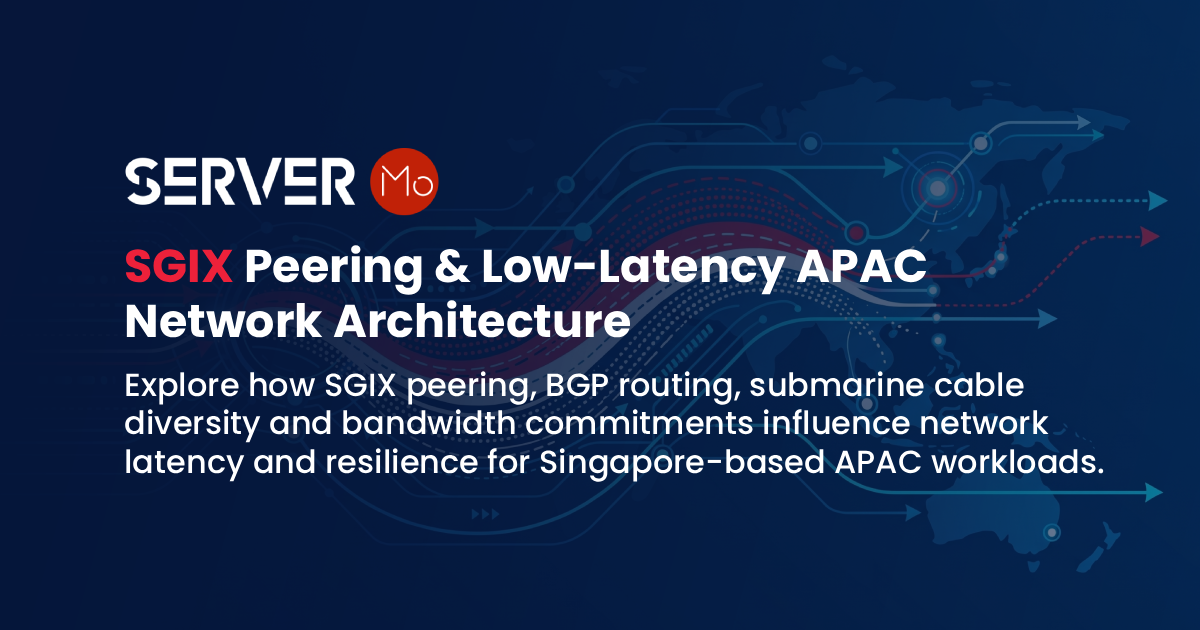
In the hyper-connected Asia-Pacific (APAC) digital economy, latency is a critical factor for enterprise application performance. Research increasingly shows that network delays directly impact user engagement and transaction completion rates. To achieve optimal performance across Southeast Asia, enterprises often evaluate network architectures that interconnect closely with local eyeball networks. At the heart of this regional connectivity in Singapore lies the Singapore Internet Exchange (SGIX).
This guide explores how anchoring your bare-metal infrastructure with optimized regional peering and Tier-1 transit affects latency, how to design resilient subsea routing, and why understanding bandwidth commitments is vital for high-frequency workloads.
1. The "Latency Anchor" Concept: Compute vs. Caching
A common architectural approach for global teams is deploying a generic cloud instance in Singapore and relying heavily on Content Delivery Networks (CDNs) to cache data. While CDNs are excellent for static assets and can handle certain dynamic content in modern architectures, they cannot entirely replace the need for core compute processing.
Workloads such as multiplayer gaming, real-time APIs, and latency-sensitive financial applications benefit from predictable network paths. High-frequency trading (HFT) environments, in particular, require workload-specific latency testing, deterministic network performance, and proximity to relevant exchanges.
By deploying dedicated bare-metal infrastructure in Singapore as your "APAC Latency Anchor," you isolate compute-intensive logic. When the hosting provider's network has suitable regional peering relationships through exchanges such as SGIX, or uses optimized upstream transit routes, workloads can benefit from more efficient paths to participating destination networks. Actual performance depends on the provider's peering coverage, BGP policies, and the destination network.
2. Peering vs. IP Transit: Routing Efficiency
Direct peering through an Internet Exchange Point such as SGIX can improve routing efficiency when the participating networks have established suitable peering relationships. However, the actual latency benefit depends on the destination network, BGP routing policies, network congestion, and the provider's upstream connectivity.
A resilient Singapore network should combine appropriate regional peering with diverse Tier-1 IP transit connectivity rather than relying on a single routing path. IP transit provides necessary global reach and fallback, ensuring that destinations not present at the local exchange remain accessible via reliable backbone carriers.
3. Singapore Regional Backbone Latency: October 2026 Reference
The following figures are based on StarHub's published October 2026 average backbone transit latency statistics. They represent StarHub's network measurements and should not be interpreted as guaranteed end-to-end RTT for other providers or individual server deployments. Furthermore, while certain submarine corridors are relevant to these destinations, the actual routing depends on active BGP paths rather than physical cable layout alone.
| Destination Metro | Illustrative Average RTT | Relevant Cable Systems / Corridors |
|---|---|---|
| Kuala Lumpur, MY | ~ 8.36 ms | Terrestrial / Cross-Straits Fiber |
| Jakarta, ID | ~ 15.47 ms | B2JS / B3JS / BSCS Corridors |
| Bangkok, TH | ~ 29.96 ms | TIS and associated regional networks |
| Manila, PH | ~ 34.94 ms | SJC / APCN-2 / SJC2 |
*Note: These are illustrative backbone statistics and do not represent guaranteed end-to-end latency for every deployment.
4. Understanding Bandwidth: Caps vs. Unmetered Commitments
Many hosting providers market "10Gbps Uplinks," but operational limits such as a 100TB monthly egress cap are common in the industry. For enterprise operations requiring continuous high-throughput data transfer, traffic caps require careful capacity planning.
Unmetered bandwidth removes traffic-volume-based egress charges within the provider's applicable service terms. However, enterprises should separately evaluate port speed, committed bandwidth, network capacity, fair-use policies, and congestion management. A 10Gbps unmetered port, for example, does not necessarily mean 10Gbps of continuously committed throughput. True enterprise deployments require alignment between the physical port and the committed capacity required to sustain volumetric traffic spikes.
5. Security & Infrastructure Resilience
Deploying in a Tier-III or Tier-IV Singapore data center provides physical security and power redundancy. However, network-layer resilience requires proactive architecture.
- Subsea Cable Resilience: The APAC region experiences seismic activities and maritime incidents that can affect submarine cables. A robust network utilizes BGP routing policies that automatically detect path failures and converge on alternate capacity. While "zero downtime" is an architectural ideal, proper multi-path failover significantly minimizes disruption and preserves application session stability during a cable cut.
- DDoS Mitigation Architecture: One common network-level mitigation technique is Remotely Triggered Black Hole (RTBH) routing, which discards traffic destined for a targeted IP address. While this can protect the wider network, it also makes the affected destination unavailable. Other approaches include traffic diversion, filtering, and inline scrubbing, depending on the provider's mitigation architecture. Effective inline scrubbing is designed to preserve legitimate traffic and minimize disruption to the hosted services.
6. Conclusion: Architecting Your APAC Presence
Achieving optimal digital performance in the Asia-Pacific market requires strategic network placement and a clear understanding of routing architectures. By combining efficient regional peering, diverse subsea cable paths, and resilient DDoS mitigation strategies, enterprises can build a highly responsive infrastructure.
Frequently Asked Questions
Singapore acts as a central digital hub for APAC. It houses a dense concentration of submarine cable landing stations and carrier-neutral exchanges like SGIX. This infrastructure combination enables efficient routing and low latency to high-growth markets like Malaysia, Indonesia, Thailand, and Vietnam.
No. Deploying infrastructure in Singapore may support an organisation's data-location and infrastructure requirements, but it does not automatically establish compliance with MAS Technology Risk Management or outsourcing expectations. Financial institutions remain responsible for assessing their hosting arrangements, third-party risks, access controls, resilience, data protection, and regulatory obligations.
Latency between Singapore and Australia depends on the destination city, submarine cable route, upstream provider, and BGP routing policy. Perth generally has a shorter geographic network path to Singapore than Australia's eastern metropolitan areas. For accurate deployment planning, request route-specific latency measurements from the hosting provider rather than relying on generic regional estimates.
Direct peering allows participating networks to exchange traffic directly, often improving routing efficiency for specific regional destinations without per-bit transit fees. Tier-1 Transit is a commercial service providing connectivity to the entire global internet. Enterprise architectures typically blend both: peering for optimized regional traffic and IP transit for comprehensive global reach.
 Your Voice Matters: Share Your Thoughts Below!
 Recent Topics for you